The Heart of the Porsche 718: A Mid-Engine Revelation
Few sports cars manage to capture the delicate balance between precision engineering and pure driving pleasure, but the Porsche 718 does so effortlessly. At the core of this balance lies one of the most defining aspects of the 718’s design: its mid-engine layout. Unlike traditional front-engine vehicles, where the engine sits over or ahead of the front axle, the 718 positions its powerplant behind the driver yet ahead of the rear axle. This isn’t just an arbitrary design choice; it’s a calculated engineering marvel that transforms every journey behind the wheel into a symphony of control, responsiveness, and visceral thrill.
The mid-engine configuration has deep roots in Porsche’s racing heritage. It’s a nod to the legendary 718 race cars of the late 1950s and early 1960s, which dominated tracks worldwide with their superior balance and agility. This layout distributes weight more evenly across the car’s chassis, drastically enhancing cornering stability and handling. In the 718, Porsche has refined this concept for the modern era, pairing it with state-of-the-art suspension technology, precision aerodynamics, and engines that are as emotionally engaging as they are technically impressive.

Precision Weight Distribution
One of the most immediate benefits of the mid-engine layout is the remarkable weight distribution it affords. Traditional front-engine cars tend to have a front-heavy bias, which can make them prone to understeer when pushing through tight corners. Rear-engine cars, like the iconic 911, offer strong traction but can feel tail-happy under abrupt maneuvers. By placing the engine just ahead of the rear axle, the 718 achieves an almost perfect balance between front and rear, creating a chassis that feels intuitively responsive.
This balance is more than a talking point; it’s a sensation. When a driver enters a corner, the car reacts predictably, almost as if it anticipates the driver’s intent. The mid-engine design allows the 718 to rotate around its center of gravity with remarkable fluidity. This isn’t merely about speed; it’s about confidence and control. Every input from the steering wheel translates directly into motion, and the car rewards precision with an exhilarating sense of connectedness to the road.
Suspension Synergy
A mid-engine layout on its own isn’t enough to make a car handle brilliantly—it must be paired with a suspension system designed to exploit its advantages. Porsche has engineered the 718’s suspension to complement its weight distribution perfectly. The double-wishbone front suspension provides a firm, precise feel, while the rear suspension is carefully tuned to manage the dynamics of a mid-mounted engine.
The result is a car that hugs corners with astonishing poise. There is no dramatic shift of weight or unexpected slides. Instead, the 718 moves like a dancer, shifting balance seamlessly as it navigates curves and elevation changes. The synergy between the mid-engine placement and finely tuned suspension is a testament to Porsche’s relentless dedication to engineering. Each component, from bushings to anti-roll bars, works harmoniously to translate raw power into controlled motion.
Aerodynamics and Chassis Dynamics
The 718’s mid-engine configuration also opens doors to innovative aerodynamic solutions. With the engine sitting behind the cabin, Porsche engineers have more flexibility to sculpt the car’s front end for optimal airflow. This reduces drag and enhances high-speed stability, a crucial factor for both everyday driving and track performance. The rear, meanwhile, benefits from the engine’s heat and airflow management, allowing for precisely placed vents and diffusers that maximize downforce without compromising efficiency.
The chassis itself is a marvel. The rigidity of the 718’s frame, combined with the low center of gravity afforded by the mid-engine layout, creates a structure that responds predictably to every driving input. It’s not just about cornering speed; it’s about driving with certainty, knowing that the car will behave exactly as expected. Even subtle maneuvers, like trail braking into a tight hairpin, feel natural and controlled. This level of feedback is rare in modern sports cars and is a key reason enthusiasts remain devoted to the 718.
Engine Placement and Driving Dynamics
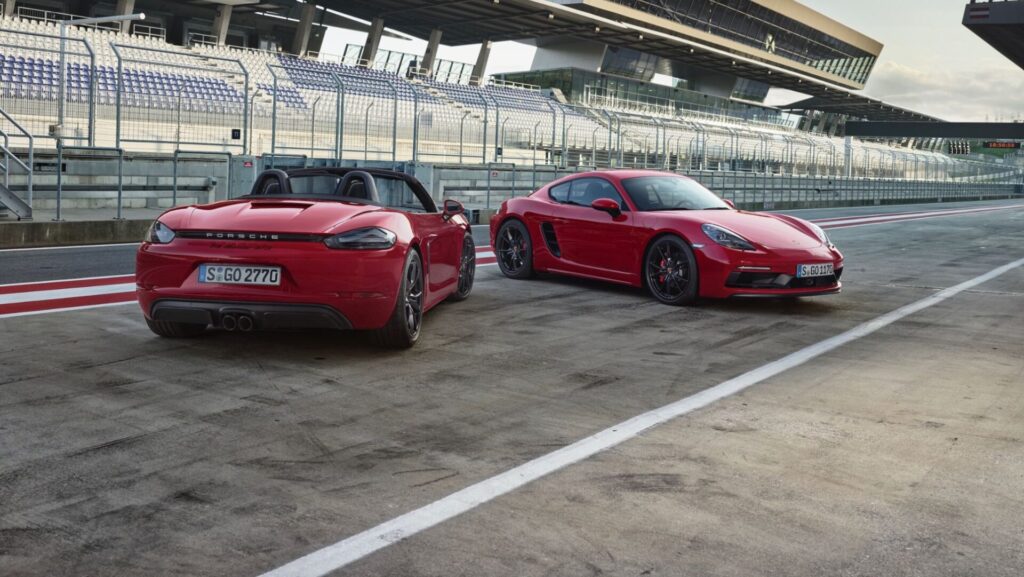
The emotional impact of the mid-engine layout extends beyond physics—it’s about how a car communicates with its driver. Sitting in a 718, the engine is within earshot, allowing every turbo spool and exhaust note to resonate naturally through the cabin. This intimacy fosters a connection between human and machine that is hard to replicate in front-engine cars. Drivers can sense weight shifts, hear the engine’s response, and feel the car’s natural inclination to rotate mid-corner.
Moreover, the 718’s engine placement enhances braking and acceleration dynamics. With significant weight over the rear wheels, traction under acceleration is superb. When braking, the balanced weight distribution prevents unsettling dives or instability, creating a sense of composure rarely felt in cars with less optimal layouts. Every aspect of the 718’s dynamic behavior is intertwined with the mid-engine design, illustrating how Porsche has engineered not just a car, but an experience.
The Engine Itself: Turbocharged Brilliance
While the layout is critical, the engine is the soul. The Porsche 718 features turbocharged flat-four engines in its base and S variants, with the Cayman GT4 and Boxster Spyder boasting naturally aspirated flat-six engines. These horizontally opposed engines are inherently well-suited to a mid-engine design, keeping the car’s center of gravity low while delivering linear power and thrilling responsiveness.
Turbocharged four-cylinders offer instant torque and efficiency, while the flat-six engines produce a richer, more visceral soundscape. Regardless of the choice, the mid-engine configuration ensures that every ounce of power is used efficiently, channeling it directly to the rear wheels for an emotionally satisfying drive. This is not just a car that moves—it’s a car that communicates, translating engineering excellence into pure driving joy.
Track-Ready Precision
The true potential of the 718’s mid-engine layout shines on a racetrack. The car’s ability to change direction quickly, maintain stability at high speeds, and balance power delivery through corners gives drivers a tangible sense of empowerment. Professional drivers and enthusiasts alike praise the 718 for its predictable yet exciting dynamics. The mid-engine setup is central to this praise—it allows the 718 to combine agility with confidence, turning what could be a frantic experience in lesser cars into something deliberate and exhilarating.
Even on imperfect roads, the benefits are clear. The car remains composed over bumps, maintains grip in tight corners, and offers feedback that allows the driver to sense exactly what the tires are doing. This level of communicative driving is the hallmark of a true sports car and a direct result of Porsche’s commitment to mid-engine engineering excellence.
Legacy and Future of Mid-Engine Design
The Porsche 718 is not just a product of contemporary engineering; it’s a continuation of a legacy. By embracing the mid-engine layout, Porsche connects modern drivers to the spirit of the 718 race cars that once dominated tracks around the world. This design choice symbolizes a marriage of tradition and innovation, showing that technical sophistication and emotional resonance can coexist seamlessly.
Looking forward, Porsche’s ongoing advancements in materials, aerodynamics, and hybrid technology promise to evolve the mid-engine concept even further. The 718 may one day incorporate electrification while retaining the weight distribution and dynamic purity that make it a legend today. Regardless of technological shifts, the mid-engine layout will remain at the heart of what makes the 718 an engineering masterpiece.

Conclusion: The Genius Behind the Layout
The Porsche 718’s mid-engine layout is more than an engineering decision—it’s the foundation of its identity. It shapes how the car feels, responds, and communicates with its driver. It enhances balance, improves handling, and allows for a driving experience that is both exhilarating and precise. From track to street, the 718 demonstrates how thoughtful engineering can transcend mere mechanics to create an emotional connection with the driver. Every corner, every acceleration, every moment behind the wheel is a reminder that in the world of sports cars, Porsche’s mid-engine ingenuity is nothing short of brilliant.
Related Posts

Volkswagen Golf R vs. Golf GTI: Which is the Ultimate Hot Hatch?
The Volkswagen Golf has long been a cornerstone of the…

Optimal Feline Wellness: A Holistic Guide to Cat Health and Nutrition
Cats are not just pets; they are beloved members of…

The Most Exclusive Bugatti Models Ever Made: A Collector’s Ultimate Guide
When you hear the name Bugatti, it instantly conjures images…